
An expired client document is an operations problem first
The document that causes trouble is never the one a client failed to upload. It is the one that was uploaded, checked, approved, and then quietly expired eleven months later while the account carried on trading.
It surfaces at the worst moment. A withdrawal request. A periodic review. A regulator asking for a file you thought was in order.
What document monitoring tracks
The Back Office and CRM tracks every document a client uploads, using the verification provider you have integrated, and flags the ones approaching expiry.
Two notices go out, not one. The client is told the document needs replacing. The compliance officer is told the deadline is coming.
That second notice is the part that changes the work. A client reminder with no internal reminder produces a client who ignores it and nobody who follows up.
Why this is an operations problem before it is a compliance problem
An expired document does not stop being operational work because it is also a regulatory issue. Somebody has to notice it, contact the client, chase the upload, review the new file and record the decision. That is five steps per document, and the documents arrive in bursts, because identity documents are issued in bursts.
Handled by hand, there are two outcomes. Either the team runs a manual audit every month, which costs days and finds problems late, or nobody runs it and an outside party finds the problem first.
Expiry monitoring is a small feature. What it removes is a recurring argument about who was supposed to be watching.
Where it sits in the rest of the system
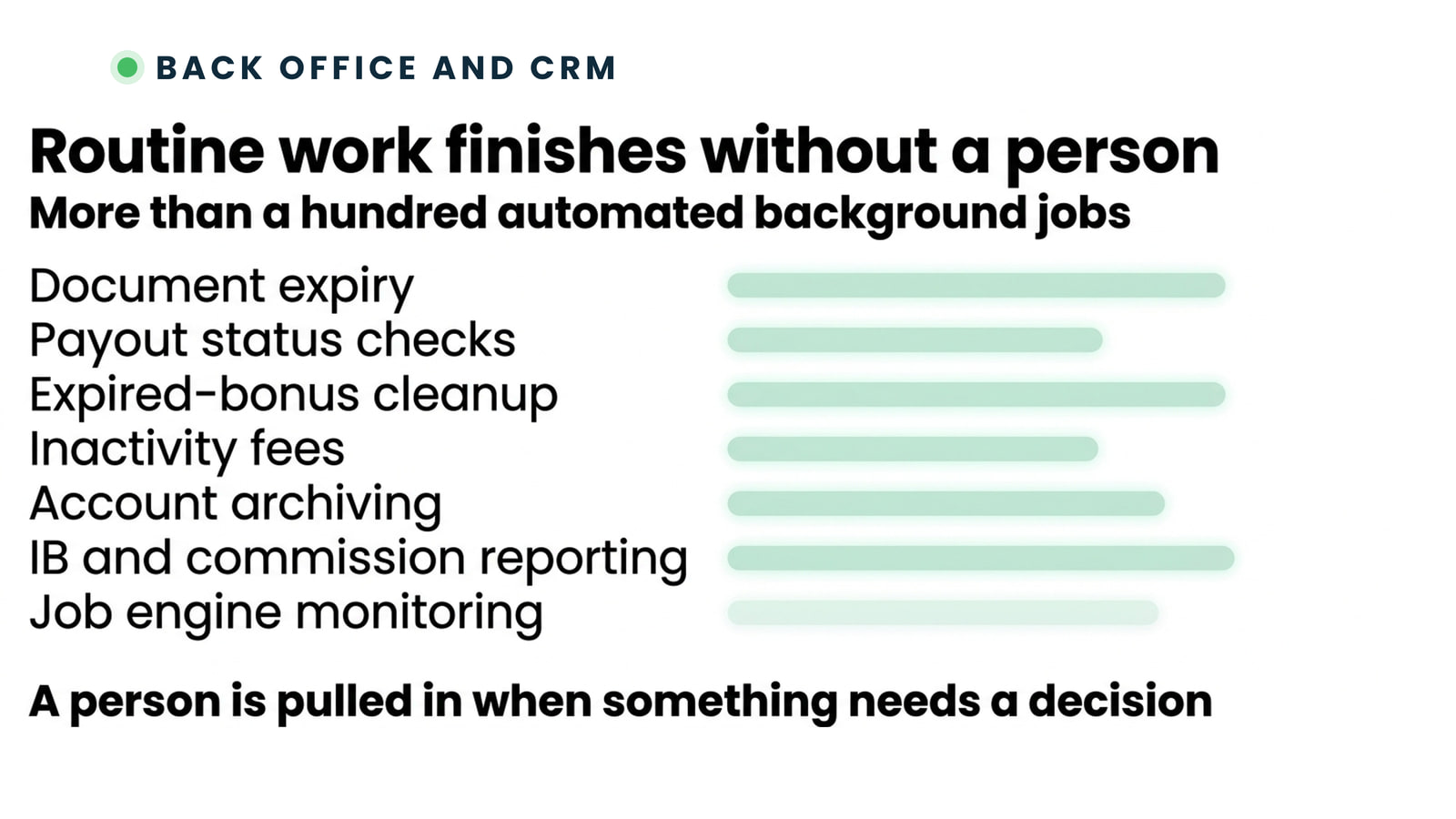
Document tracking is one of more than 100 automated background jobs in the Back Office and CRM. Others handle payout status checks, expired-bonus cleanup, inactivity fees, account archiving, IB and commission reporting, and monitoring of the job engine itself.
The pattern is the same in all of them. Routine work finishes without a person, and a person is pulled in when something needs a decision. A separate data-archiving module supports the retention side, so records that must be kept are kept and the rest have a route out.
None of this makes a brokerage compliant. It makes the compliance calendar visible and puts the reminder in front of the two people who can act.
Three questions worth answering about your own setup
- How do you find out today that a client document has expired?
- Does anyone internal get told, or only the client?
- If a regulator asked for your expiring-document list this afternoon, how long would it take to produce?
If the answer is measured in days, your queue is carrying work software should carry.
We build the client-lifecycle side of this in the Back Office and CRM. If you would like to see the document and job engine running on a real configuration rather than a slide, tell us what your onboarding queue looks like and we will set up a walkthrough.
More news

Two places to put a markup, and why the difference matters
A markup on the price stream and a markup at execution are different controls. How calendar-based spread limits and throttling fit alongside them.
Read more →
Execution routing that lives inside the trading platform
Seven conditions, four actions and a configurable execution delay, built into The Edge. Routing control without necessarily adding a separate bridge.
Read more →
Sixty-five payment providers is not the number that matters
More than sixty providers integrated directly, per-country control of what each market sees, and a status-checking job per provider so states reconcile.
Read more → sales@finstek.com
 +44 330 822 6201